If you have any questions about the PUMA share and the financial results of PUMA SE, our Investor Relations team will be happy to help you. Please be aware that we will not reply to questions relating to non-Investor Relations topics.
Nachhaltigkeit
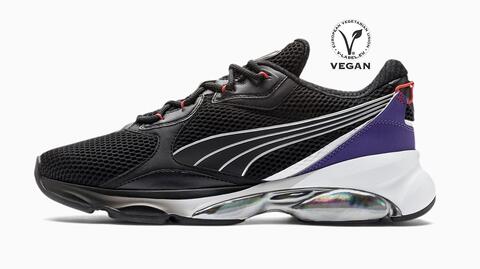
PUMA is steadily increasing its offer for people who lead a vegan lifestyle and who want to avoid all kinds of animal products, not just in their food but also in their clothes. But what makes a vegan shoe vegan?
What it takes to make vegan shoes
Nachhaltigkeit
In 2020, we already achieved an important milestone by sourcing 100% of the core materials used in our Apparel and Accessories, such as down, viscose and cotton, from more sustainable sources. Above 97% of other materials such as leather, polyester and cardboard also came from certified sources in 2020. This means that 5 out of 10 PUMA products were made from more sustainable materials last year. Our Aim: By 2025, nine out of ten PUMA products will be made of more sustainable materials.
Forever Better
PUMA CREATES MORE SUSTAINABLE FOOTWEAR STYLES USING SUGAR CANE AND RECYCLED MATERIALS
Nachhaltigkeit
Earlier this year, we announced that by 2025, nine out of ten PUMA products will be made of more sustainable materials. As part of this commitment, we will introduce a new midsole which is made with sugarcane. We have also launched two new footwear styles made with recycled materials.
Better Foam, which will be used in footwear products starting this summer, contains at least 35% bio-based materials which are derived from sugar cane.
Sugar cane absorbs carbon as it grows and the parts of the plant which are not destined for food production are blended into traditional foam cushioning to make Better Foam.
A midsole made of Better Foam will first be used in the Emerge, a stylish training shoe which will be sold starting July 1.
PUMA CREATES MORE SUSTAINABLE FOOTWEAR STYLES USING SUGAR CANE AND RECYCLED MAT…
PUMA commits to protecting forests in partnership with NGO Canopy
Nachhaltigkeit
Today we are announcing another step towards Forever Better. We have committed to protecting forests around the world when sourcing paper, cardboard, and viscose, as part of our new partnership with not-for-profit environmental organization Canopy.
By 2022, we will source all of our cardboard and paper packaging from recycled or certified sources to ensure they are not derived from the world’s most integral forests. When we use viscose in our products, the raw material must come from top-of-class fibre producers which are regularly audited and then ranked by Canopy in its Hot Button Report. By procuring only from suppliers that achieve a top rating from Canopy, we avoid the risk of sourcing from ancient or endangered forests.
PUMA commits to protecting forests in partnership with NGO Canopy
Bees arrive to make honey on green roof of our Geiselwind distribution center
Nachhaltigkeit
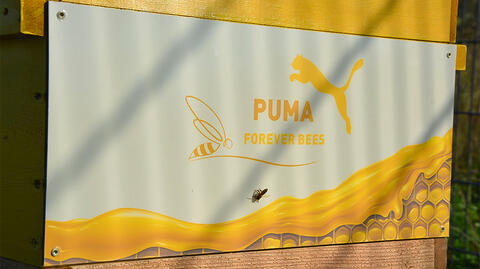
Our distribution center in Geiselwind received 60,000 new employees on Wednesday… very small ones. Four bee colonies will make honey from the nectar they collect around the center and on its green roof of 14,000 square meters.
Sustainability was an important part of the development of the Geiselwind distribution center, which started operations earlier this year. Apart from the large green roof, the center is also powered by green energy and it has a rain water utilization system. With all of these measures, PUMA aims to receive a LEED-Gold certification, a standard given to very sustainable buildings.
Bees arrive to make honey on green roof of our Geiselwind distribution center
Nachhaltigkeit
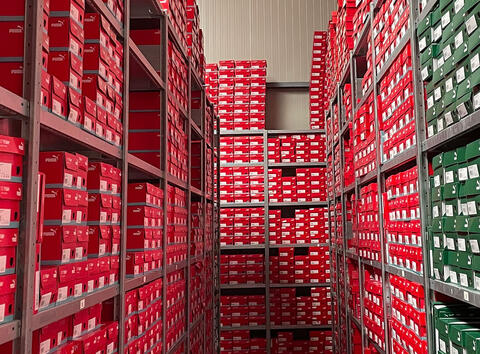
The shoeboxes you see in our stores today look the same as they always have, red, green or black, but now they have a secret: They use significantly less cardboard than they did before.
As part of its 10FOR25 targets, PUMA is looking at the environmental footprint of the company as a whole and aims to embed sustainability into all of our products to make a positive impact at scale. Better packaging is part of that journey.
“We took a holistic look at the design of our shoeboxes, and we realized that we were using too much material,” said Jordan Eichenberger, Head of Labelling and Packaging at PUMA Group Sourcing.
Jordan and his team started a redesign of the boxes and looked for ways to reduce the amount of material used, while keeping the boxes just as sturdy as before.
By using less material in our shoeboxes, we save 2800 tonnes of cardboard per year. If we consider that it takes about 12 trees for a tonne of cardboard, reducing the weight of the shoe boxes has saved 33600 trees – more trees than in New York’s Central Park.
But we are even going one step further, as the cardboard boxes are made of more than 95 % (by weight) recycled cardboard.
As a part of our 10FOR25 strategy, we will also eliminate consumer-facing plastic bags from our owned and operated stores and, wherever possible, make our retail supplies more sustainable.
Our consumer-facing plastic bags are already made of 80% recycled content but in 2021, we cut their use in half. To put it into numbers, that is 200 tonnes of plastic we did not use.
But we will not stop there. While we have already eliminated consumer-facing plastic bags from our owned and operated stores in countries such as China and India, we will stop using such plastic bags anywhere in the world by 2023.
Instead, PUMA will only use recycled and FSC-certified paper bags in its stores, no matter whether you shop in Herzogenaurach, on Fifth Avenue or in Krasnoyarsk.
The switch to more sustainable alternatives for our shoppers wasn’t without challenges, as Martina Lagler, Senior Teamhead Global Retail Business Development, explains.
“In general, recycled paper is not as durable as plastic, so the development phase was quite a challenge and I am super happy that we are finally able to offer such a high-quality bag. We also had to make sure to have the relevant documents in place to prove full traceability throughout the production supply chain of the material and its recycled content,” Martina recalls.
And there is more happening in our stores: Our customers who want to wrap their PUMA purchases for a special someone, will also receive a gift bag made of recycled and FSC-certified paper soon. The bags PUMA uses for shipping online orders will also be made with 100% recycled plastic and we found more sustainable alternatives for the hangers and shoe trees in our stores.
Other packaging improvements may be less obvious to PUMA customers, as they are only used to keep our products dry and clean during transport. But the polyethylene bags that protect our apparel and accessories on their way to the store and in warehouses will also be made exclusively from recycled polyethylene by Spring/Summer 2022. We also reduced the average thickness of these bags from 50 to 30 microns, a 60% reduction which once again saves 400 tonnes of material per year.
With all of these measures, we will take another step on our journey to make PUMA more sustainable and be FOREVER BETTER.
Forever Better Packaging
NachhaltigkeitSport
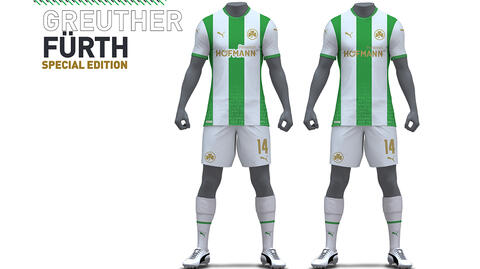
German football club SpVgg Greuther Fürth sensationally made it to the Bundesliga for the 2021/22 season. With the celebration of the club´s birthday and the high class match between Fürth and record champion Bayern Munich last Friday, we had more than one good reason to produce a special jersey. After a smooth and fast design process with the club, the production phase was challenging. Below you can find an interview with our sourcing specialists to learn about the roller coaster of emotions on the way from Vietnam to Southern Germany and how the team managed the difficulties.
THANKS TO OUR APPAREL SOURCING HEROES!
Nachhaltigkeit
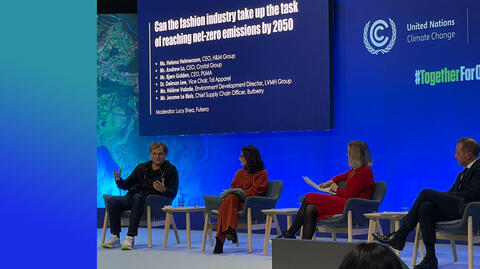
PUMA reiterated its commitment to the fight against climate change and global warming at the United Nations Climate conference in Glasgow this week. With alarming reports about global temperature rises and extreme weather, PUMA recognises the fashion industry’s important role in decarbonisation.
PUMA CEO Bjørn Gulden on Monday joined a panel to talk about the fashion industry’s path towards becoming carbon neutral and said he was optimistic. But he also called on governments to help companies in their fight.
No time to waste
Nachhaltigkeit
Would you like to test our new RE:SUEDE? With the RE:SUEDE project, PUMA has the ambition to set new standards of sustainability for our iconic SUEDE. We´ll test whether the sneaker can biodegrade in the controlled setting of an industrial composting facility. Right now, we are looking for 500 people in Germany to join our brand ambassadors such as Cara Delevingne and Raphaël Varane. Are you in?
Join our RE:SUEDE experiment in biodegradability!
RE:JERSEY – PUMA trials Garment-to-Garment Recycling in Circularity Project, using old Football Kits to produce new ones
Nachhaltigkeit
We will pilot an innovative production process to use existing football jerseys to produce new ones. This initiative is aimed at reducing waste and paving the way towards more circular production models in the future. The process used in RE:JERSEY means that old garments that feature logos, embroideries and club badges, which previously hindered recycling efforts to turn old garments into new ones, can now be used. The RE:JERSEY project takes football kits as the major ingredient to create yarn for new jerseys. The products made in the RE:JERSEY project will be worn on-pitch during pre-match warm-ups by PUMA Clubs Manchester City, AC Milan, Borussia Dortmund and Olympique de Marseille. The teams will wear the jerseys ahead of their respective league fixtures in late April and May, starting with Manchester City on April 23. Check them out!
RE:JERSEY – PUMA trials Garment-to-Garment Recycling in Circularity Project, us…
PUMA’s circularity project RE:JERSEY takes center stage ahead of Manchester City match
Nachhaltigkeit
On Saturday´s match against Watford, Manchester City players wore special PUMA jerseys, which were made using repurposed football jerseys as part of our innovative recycling project RE:JERSEY. Learn more!
RE:JERSEY aims to reduce waste and pave the way towards more circular production models in the future. While our PUMA football kits on the market today are already made from 100% recycled polyester, the RE:JERSEY shirts worn ahead of Saturday’s game are made with 75% repurposed football jerseys. The remaining 25% comes from SEAQUAL ® MARINE PLASTIC.
Participate in RE:JERSEY!
Starting today, we will set up special collection bins at the City Store next to the Etihad Stadium to invite fans to donate their old polyester items so they can become a part of this garment-to-garment recycling project. The club will also set up take-back bins in other parts of the Etihad Campus.
PUMA’s circularity project RE:JERSEY takes center stage ahead of Manchester Cit…
 https://www.puma-catchup.com/wp-content/uploads/2021/01/veganshoe.jpg
 https://www.puma-catchup.com/wp-content/uploads/2021/05/Head-Sust.jpg
 https://www.puma-catchup.com/wp-content/uploads/2021/06/Betterfoam-Emerge_catchup.jpg
 https://www.puma-catchup.com/wp-content/uploads/2021/06/Header-Hilton-Leuser.jpg
 https://www.puma-catchup.com/wp-content/uploads/2021/09/MicrosoftTeams-image-2.jpg
 https://www.puma-catchup.com/wp-content/uploads/2021/08/shoeboxesheader.jpg
 https://www.puma-catchup.com/wp-content/uploads/2021/09/Header-GF.jpg
 https://www.puma-catchup.com/wp-content/uploads/2021/09/Cara-Delevigne-Header.jpg
 https://www.puma-catchup.com/wp-content/uploads/2021/11/newheaderunclimate.jpg
 https://www.puma-catchup.com/wp-content/uploads/2022/02/Resuede-Header.jpg
 https://www.puma-catchup.com/wp-content/uploads/2022/03/Header-Rejersey.jpg
 https://www.puma-catchup.com/wp-content/uploads/2022/04/REJERSEY_CATchUpHeader.png