PUMA Timeline
Since 1948, PUMA has made history alongside some of the world’s most famous athletes, occupying an important position in sports and sports culture. Supported by one of the most significant archives in the industry, the brand stands for unforgettable moments, great innovations and products that have been popular with consumers for decades. You can find out more about PUMA’s unique history below.

The first step in a long history of sports and sports culture is marked by Rudolf Dassler and his younger brother who founded the company “Gebrüder Dassler Schuhfabrik” (Dassler Brothers Shoe Factory) in their hometown Herzogenaurach, Germany. While the town was home to many shoe factories at the time, the Dassler Brothers were the first to specialise in sports shoes. In doing so, they laid the foundation for an entire industry.
The brothers started their factory in their parents’ home in 1919, and entered "GeDa" into the commercial register on 1st July 1924.


Within the first few years, their products became well known and the majority of German athletes wore "Gebrüder Dassler" spikes at the Summer Olympic Games in Amsterdam, 1928 and in Los Angeles, 1932. In 1936, Jesse Owens won four gold medals at the Olympic Games in Berlin, wearing “Gebrüder Dassler” spikes. This marked the brothers’ international breakthrough.

“Mr. PUMA” Helmut Fischer | Founder of the PUMA ArchiveHerzogenaurach has been a shoe making town since the 19th century. And over the years it developed into the world's sport shoe capital.


The company was registered as a business in January 1948. Operations commenced on June 1, 1948. Four months later on October 1, 1948, the PUMA brand was born and registered at the German Patent and Trademark Office. The details of the new company were added to Germany’s commercial register on January 14, 1949.
“Rudolf’s vision was that all of his products would give athletes the characteristics of a puma cat: speed, strength, endurance and agility.” - Helmut Fischer
1950s
Innovating Football
After the major success of PUMA’s first football boot, the ATOM in 1950, the launch of the SUPER ATOM in 1952 sparked a revolution. Rudolf Dassler collaborated with experts, such as West Germany’s national coach Sepp Herberger, to develop the world’s first boot with screw-in studs. Players from important teams at the time, such as Hungary’s “Golden Team” and two-time World Cup winners Uruguay, left great reviews. This marked the beginning of PUMA’s successful history in football.


First Successes
In 1952, the first Olympic Games after the split of the Dassler brothers were a huge success for PUMA, with gold medals for Luxembourgish athlete Josy Barthel in the 1500m and the US 4x100m relay team.
In 1954, PUMA running shoes set their first world record. Heinz Fütterer matched Jesse Owens’ 100m world record in Yokohama, Japan with a time of 10.2 seconds.


FORMSTRIP
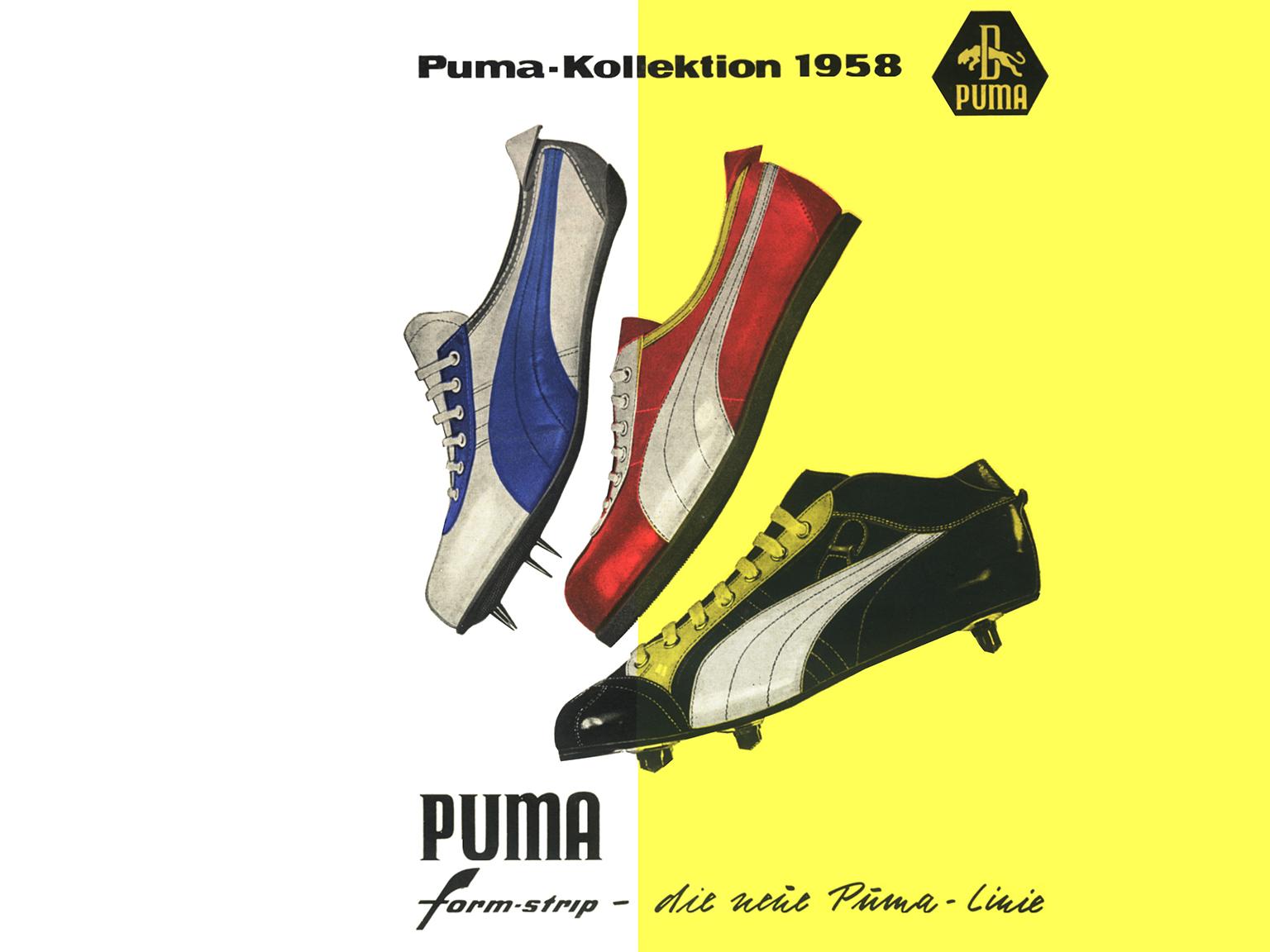
In 1958, PUMA patented one of its most famous trademarks: the FORMSTRIP. Originally created as a strip of leather to stabilise the foot inside the shoe, the FORMSTRIP is until this day found on almost all of PUMA's footwear and also used as a design element on apparel products. It was just in time too - thanks to sports being increasingly shown on television in the 1950s, the FORMSTRIP became visible all over the world!
Learn more about the FORMSTRIP here.

1960s
Athletic Excellence
In Rome 1960, German Armin Hary spectacularly took the 100m gold. Four years later in Tokyo, Ethiopian long-distance runner Abebe Bikila secured his second Olympic Marathon gold in a world-record time, while Belgian Gaston Roelants won gold in the 3000m steeplechase and Mary Rand leapt to victory in the long jump. Rand became the first British female to win an Olympic gold medal in track and field.


Long Live The KING
Portuguese striker sensation and Ballon d'Or winner Eusébio became top scorer in the 1966 World Cup in England, wearing PUMA football boots.
Honouring this accomplishment and Eusébio's continued fantastic form, PUMA introduced the legendary PUMA KING football boot in 1966.
Learn more about the KING here.


Rising Up
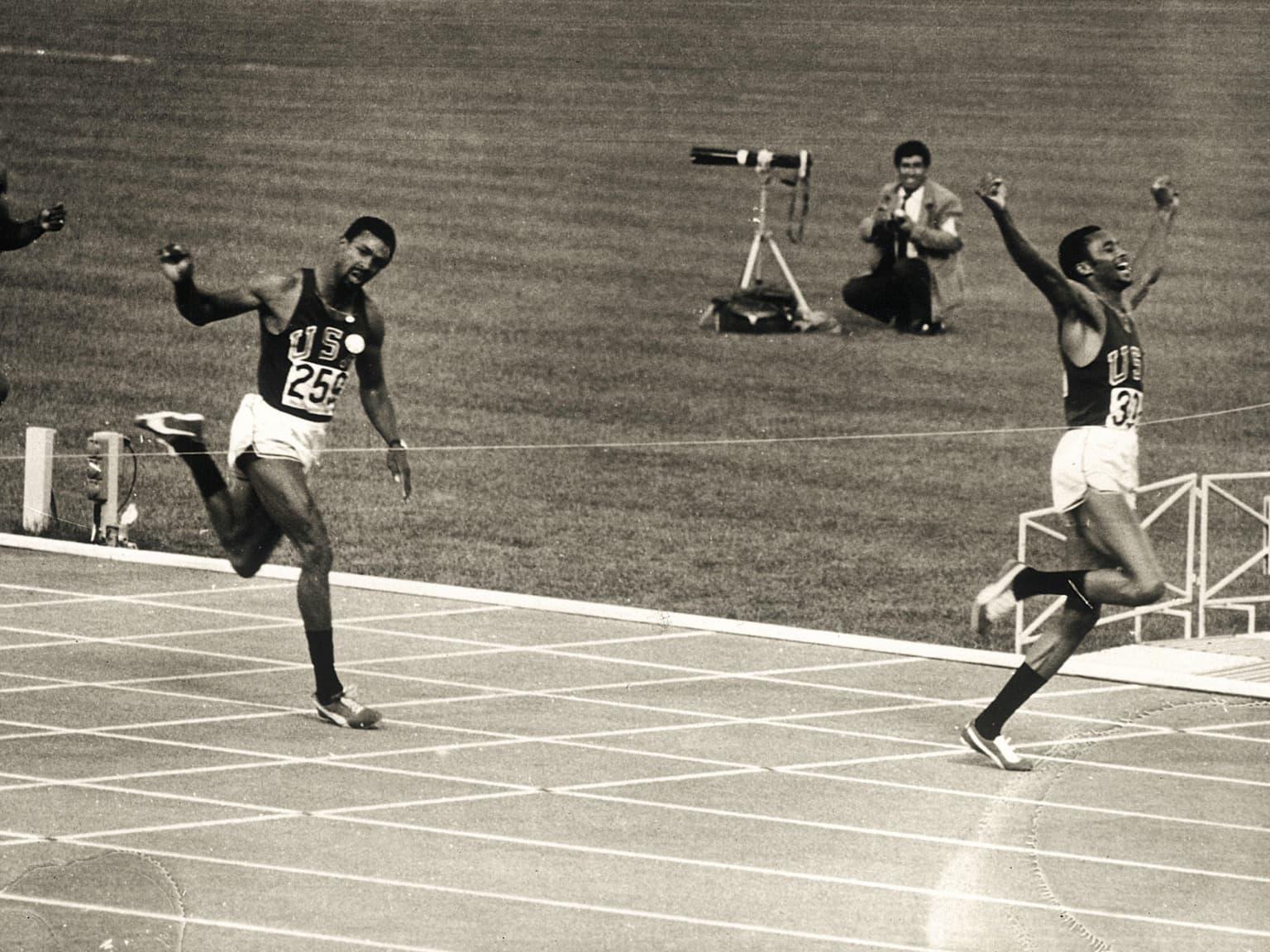
With the creation of the PUMA TAHOE brush spike, PUMA equipped numerous American athletes and set the 200m and 400m world records at South Lake Tahoe prior to the 1968 Summer Olympic Games in Mexico City. For the first time, the innovative spike combined a suede upper and a hook and loop closure with a sole featuring 68 spikes, each 4mm in length. The spikes were placed in six rows on the forefoot to provide better traction on the newly introduced artificial tartan tracks. The shoe was a short-lived triumph as it was deemed “too dangerous” and banned by the association.



T7
PUMA entered the sports apparel market to cater for the growing number of athletes and teams in sport. With the FORMSTRIP implemented as a 7cm wide, conically tapered, colour-contrasting band along the sleeves, the iconic T7 training suit made its debut.
Learn more about the T7 here.


1970s
1970
Fit For A KING
Keen to always have the very best players wearing its KING football boots, PUMA signed “Football Player of the Century” Pelé, who became a long-term member of the PUMA Family.
With the PUMA KING, Pelé dominated the 1970 World Cup, earning him the title “Player of the Tournament” as Brazil secured its historic third World Cup trophy.


1973
Style Icon
New York Knicks’ point guard Walt Frazier was known on the basketball court by winning two NBA Championships with his intelligent defensive play. Off the court, he made a name for himself with his signature style. This earned him the nickname “Clyde” after the movie character from “Bonnie and Clyde”. When he asked for a custom-made pair of basketball shoes, PUMA was immediately game and created the PUMA CLYDE. Not only did this make Frazier the first professional basketball athlete with a signature shoe, but it also launched Frazier’s iconic CLYDE combination: FORMSTRIPs, fedoras and long sideburns.


When PUMA returned to basketball in 2018, it launched the CLYDE COURT DISRUPT, which paid homage to the original CLYDE while signaling a new era that combined the sport with fashion, art, and music. With signature stars like LaMelo Ball, Breanna Stewart and Tyrese Haliburton leading the way, PUMA redefined basketball footwear as a canvas for both performance and cultural expression.


1974
The True (FORM)Strip
At the 1974 World Cup in West-Germany, Dutch team captain Johan Cruyff chose a special way to show his love for PUMA. Saying he felt so connected to the company that he could not play in another brand’s apparel, he wore a custom-made PUMA kit featuring only two stripes on his sleeves, whereas his teammates wore three. Dominating the tournament with his signature Cruyff turn, he wrote football history and bagged the “Player of the Tournament” title. He later won the Ballon d’Or for the third time.


Armin Dassler
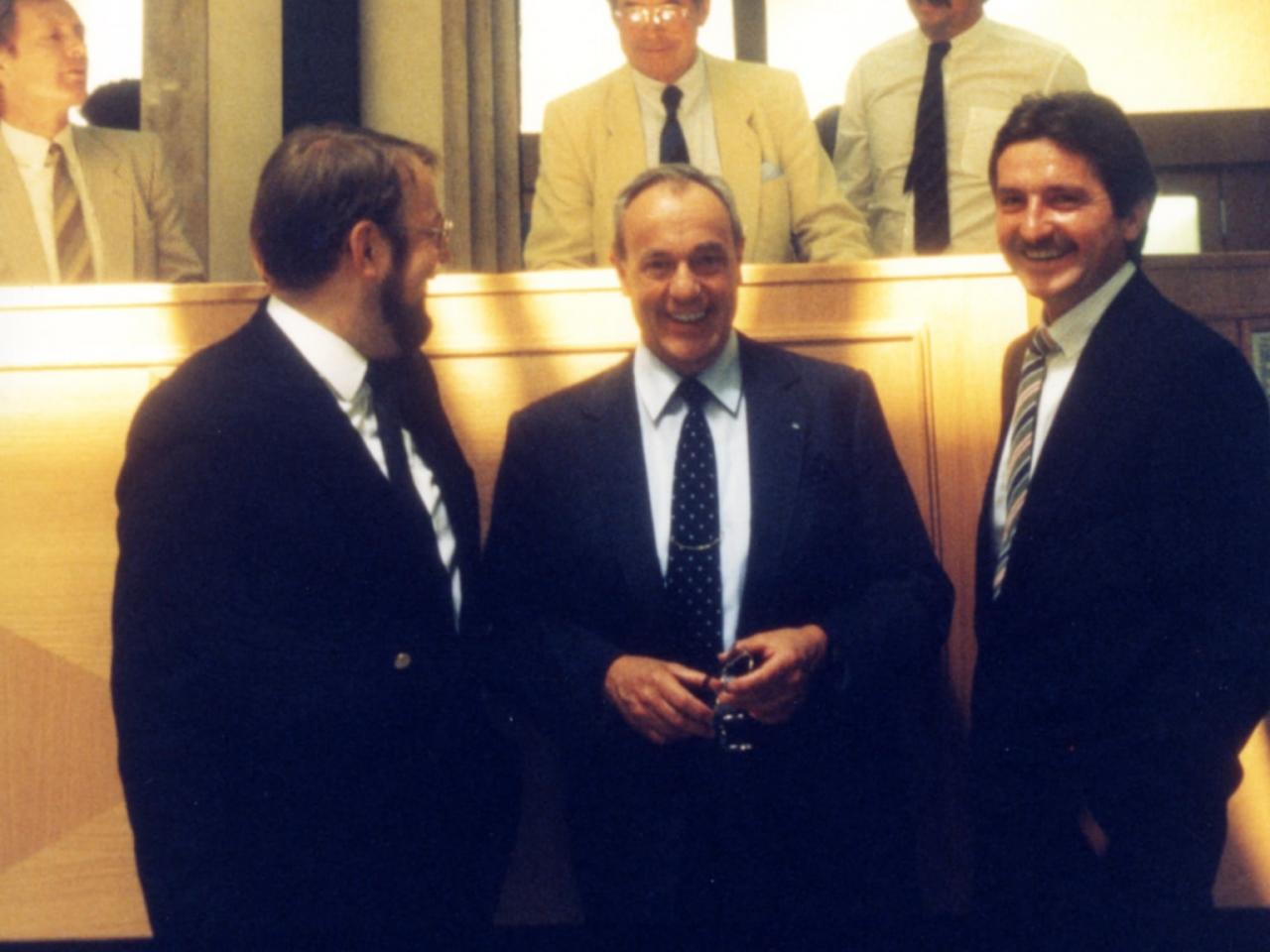
Following the passing of founder Rudolf Dassler (center), his son Armin Dassler (left) assumed the role of CEO. Like his father before him, Armin is a trained shoe technician, making him a natural successor. Under his leadership, PUMA entered a phase of international expansion, stronger athlete partnerships, and a renewed focus on performance innovation.
1970s
El Toro & El Matador
PUMA athletes dominated the world stage as Guillermo Vilas rose to the top of tennis with multiple major titles in 1977, while Mario Kempes became the star of the 1978 FIFA World Cup, winning the Golden Boot and leading Argentina to its first World Cup victory.


1980s
Grand Slam
PUMA’s tennis roster kept expanding. Martina Navrátilová, the dominant force of her era, amassed a stunning 167 singles and 177 doubles titles, including an Open Era record 59 major titles. One of the most successful players of the 1980s, she became one of few women to win all Grand Slams and remained the only player to hold the No. 1 spot in singles and doubles for over 200 weeks.
PUMA’s dominant role in tennis in the 80s peaked with 17-year-old Boris Becker and his spectacular victory at Wimbledon in 1985. Becker was the youngest, the first unseeded and the first German player to win the tournament. With PUMA shoes and a PUMA racket at his side, Becker worked closely with the company to craft signature footwear that stabilized the ankle and encouraged bold, fearless play.


1985
The World's First Smart Shoe
In 1985, PUMA developed a new cushioning system: the Running System, now known as RS. The RS sole combined four components with different physical and chemical characteristics into one unit to absorb shock and control motion. Based on this new running technology, the first-ever computer shoe was created: the RS-Computer. It recorded data during a run and gave runners the ability to compare past runs with future goals, learning and understanding how to become faster, more efficient, and competitive.


1986
PUMA AG
The company went public as PUMA AG and PUMA stock was traded on the Munich and Frankfurt stock exchanges for the first time.
Yo Soy Un PUMA
Diego Armando Maradona went down in history with his second goal against England in the quarter finals of the 1986 World Cup in Mexico. Starting from his own half, he passed six players including the goalkeeper, touched the ball eleven times with his PUMA KINGs and scores the "Goal of the Century".
Learn more about Diego Maradona here.


1990s
1990
Homegrown KING
PUMA KING footballer Lothar Matthäus, who was born and raised in PUMA's home town Herzogenaurach, captained West-Germany to its third World Cup title in Italy. Subsequently, he won the Ballon d'Or ("European Player of the Year") and was named "World Player of the Year" and "World Athlete".


1991
Turn It On
PUMA launched the game-changing PUMA DISC System technology for running shoes, creating faster lacing on even faster shoes.
Launched in 1991, the DISC System was the first laceless sports shoe. When turning the DISC, the system of internal wires tightened the upper for an optimal fit. This worked perfectly in tandem with PUMA’s cushioning technologies TRINOMIC (1990) and its successor CELL (1997).


1990s
Athletic Dominance
PUMA athletes defined a decade of track and field excellence. At the 1992 Barcelona Olympics, Heike Drechsler (long jump) and Linford Christie (100m) won gold. The mid-to-late ’90s saw continued world-class performances: Colin Jackson (1993 110m hurdles WR & World Champion), Merlene Ottey (1993 - 100m World Champion), Jonathan Edwards (1995 triple jump WR & World Champion), Daniel Komen (1996 300m WR and 1997 5000m World Champion) and Noah Ngeny (1999 1000m WR and 2000 1500m Olympic gold) all cemented PUMA’s legacy in speed, endurance, and record-breaking performances.


1996
Eyes of a Cat
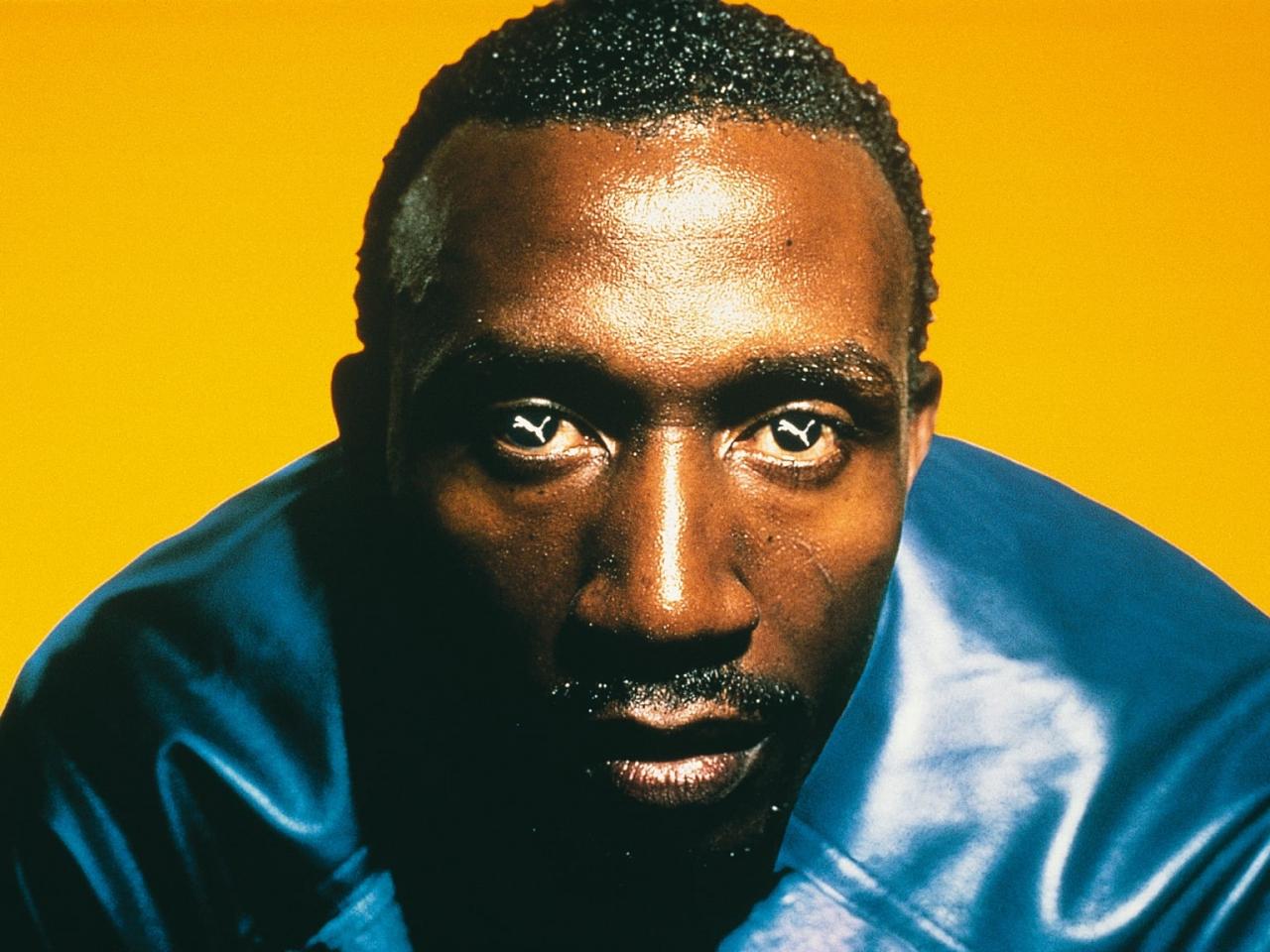
At a press conference prior to the 1996 Summer Olympic Games in Atlanta, Linford Christie became the centre of attention when he wore special contact lenses with the PUMA cat. The picture of Christie wearing the PUMA lenses spread rapidly and became world famous.
Learn more about Linford Christie's iconic moment here.
1998
Sportstyle
In collaboration with German star designer Jil Sander, PUMA merged sports and fashion for the first time. The iconic KING and running shoe EASY RIDER were combined to create a lifestyle version that became a desired fashion sneaker, opening up the sport lifestyle segment.


1999
Turning Up a Gear
The original RACE CAT debuted as a low-profile, fireproof racing shoe for Formula One drivers, featuring the stitched cat logo and an elegant, performance-driven design. Its low-cut lifestyle pendant SPEEDCAT in 2000 quickly turned into a functional icon and a fashion classic.
PUMA also deepened its connection with motorsports. Since 2005, PUMA has partnered with Ferrari, supplying racing gear and merchandise to drivers like Michael Schumacher, Kimi Räikkönen, Fernando Alonso, Sebastian Vettel and Charles Leclerc solidifying its position as a top supplier in the sport.
Learn more about the PUMA in Formula One here.


2000s
Indomitable Lions (and Lioness)
At the 2002 African Cup of Nations in Mali, the PUMA-sponsored Cameroon national team shook things up with unprecedented sleeveless kits, taking home the title. Ahead of the 2002 World Cup in South Korea and Japan, FIFA banned the sleeveless kits, forcing PUMA designers to come up with a new creative solution: black mesh sleeves that allowed for the iconic silhouette to remain seen.


At the French Open in 2002, PUMA and Serena Williams unveiled a dress in Cameroon’s colours, inspired by the national team’s sleeveless jerseys. Later at the US Open, Serena caused a stir with the skin-tight “Catsuit”. It was an incredible year for Serena, who cemented her status as the No.1 in the world after winning three consecutive Grand Slam tournaments.
2004 was a year in which PUMA stood with its partners through success and challenges. The Cameroon national team followed up on their eye-catching 2002 sleeveless kits with an even more daring one-piece and skin-tight PUMA UniQT gear. While the kits were developed by PUMA with fair play in mind, the Indomitable Lions were fined and had six points in their 2006 World Cup campaign revoked. PUMA showed itself as a real team player by supporting the Cameroonian team in a legal dispute that ended in a compromise and a shared donation to a football development project in Cameroon.

2006
World Champion
At the 2006 FIFA World Cup in Germany, PUMA sponsored 13 of the 32 teams, more than any other supplier. For the first time in history, a PUMA-backed team won the tournament, as Italy defeated France 5:3 on penalties. Italy’s goalkeeper Gianluigi Buffon, wearing PUMA gloves, claimed the Yashin Trophy as the tournament’s best goalkeeper.
2009
Lightning Bolt
Just one year after his Beijing 2008 Olympic triumph, Usain Bolt broke his own 100m world record with a time of 9.58 seconds and his 200m record in 19.19 seconds at the 2009 World Championships in Berlin, also claiming gold in the 4x100m relay. Bolt continued his unbelievable performance at the 2012 London Olympics, winning triple gold in the 100m, 200m, and 4x100m relay, and again at the 2016 Rio Olympics, securing the same triple-gold sweep, solidifying his legacy as one of PUMA’s greatest athletes and the fastest man in history.


2010s

Racing Dominance
Between 2014 and 2022, PUMA-equipped racing teams won 9 consecutive Formula 1 Drivers’ and Constructors’ World Championships, with stars like Lewis Hamilton, Nico Rosberg and Max Verstappen.
In 2020, Lewis Hamilton won his seventh Formula 1 World Championship, equalling Michael Schumacher for the most won championships.

2010
COBRA PUMA GOLF
PUMA first made its mark in the golf world in 2006, jumping into the category with stylish and performance ready apparel, footwear and accessories that helped golfers of all levels enjoy the game and play with confidence and style. PUMA’s golf business grew in 2010 with the acquisition of Cobra Golf, a brand known for technology-rich, game-changing equipment. Together, COBRA PUMA GOLF delivers a full 360 package of innovative golf products and fashion-forward styles to consumers.
2014
FOREVER FASTER
PUMA launched its FOREVER FASTER brand campaign in a mission to become the fastest sports brand in the world. FOREVER FASTER recognised individuality and embraced challenging conventions and taking risks through bravery, confidence, determination and joy. Headlined by the fastest man alive Usain Bolt, footballers Mario Balotelli, Sergio Agüero, Marco Reus, Cesc Fabregas and Marta da Silva, and golfers Rickie Fowler and Lexi Thompson, FOREVER FASTER aimed to capture the PUMA spirit and mentality.


2015
Challenge Convention
PUMA and artist Rihanna joined forces as she became PUMA Women’s Creative Director and Ambassador.
Rihanna’s first collaboration with PUMA was an instant classic. Taking inspiration from the creeper sneaker silhouette that was popular in the punk era, the PUMA SUEDE was recreated with an extra thick sole and the PUMA CREEPER was born.


2019
stichd
After PUMA acquired its Dutch licensee Dobotex in 2012, a new chapter began as it combined with logistics group Dobologic and merchandising specialist Branded to relaunch with a new brand identity: stichd. stichd designs, develops, produces and distributes socks, fanwear, swimwear and bodywear.
2020s
The FUTURE Is Now
Since 2017, PUMA has driven football innovation with its creative FUTURE, fast ULTRA and legendary KING silos. PUMA also doubled down on its Women’s Fit legacy, which started with the PELÉRINA in 1971. With the first ULTRA for women in 2021, the Brilliance Pack in Women’s fit in 2023, and the refined Women’s Fit 2.0 in 2025, PUMA continued to develop and deliver elite performance tailored to female athletes.


A New Era Of Performance
PUMA entered a new era of performance, driven by its NITRO™ technology in 2021. Athletes shattered boundaries, setting world records with Karsten Warholm (2021, 400m hurdles), Devynne Charlton (2024, 60m hurdles), Yaroslava Mahuchikh (2024, high jump) and pole vault superstar Mondo Duplantis, while claiming Olympic and Paralympic gold medals with stars like Gianmarco Tamberi (2021, high jump), Julian Alfred (2024, 100m) or Felix Streng (2021, 100m), redefining speed, power and excellence on the global stage.


Since the launch of NITRO™ in 2021, PUMA has continued to develop this technology to minimise energy loss and allow for more efficient and faster movement. With the FAST-R 3 NITRO™ ELITE, PUMA released its fastest and lightest ever running shoe ever in 2025. It was named one of the best inventions of the year by Time Magazine.


Golden Generation
Since 2016, Denmark has dominated international handball, winning 2 Olympic golds (2016, 2024) and 4 World Championships (2019, 2021, 2023, 2025) and a European Championship (2026), with standout player Mathias Gidsel recognized as the world’s best handballer in 2023, 2024 and 2025.

2023
PUMA75
Sports company PUMA and several of its world-class ambassadors shared some of their most memorable moments in sports history of the past 75 years to celebrate the company’s anniversary.
2025
Powering Hybrid Fitness Racing with HYROX
PUMA quickly recognised the enormous potential of hybrid fitness racing and partnered with HYROX since the first race in Hamburg in 2017 before becoming a global partner in 2023. In 2025, PUMA launched the first-ever purpose-built HYROX shoe: the PUMA Deviate NITRO™ Elite HYROX. Designed for the sport’s gruelling blend of running and functional fitness racing, the shoe features HYROX-tuned PUMAGRIP rubber (for explosive traction on indoor surfaces) and a widened carbon plate (for stability and energy return). Learn more about the development of the PUMA Deviate NITRO™ Elite HYROX here.
With HYROX attracting millions of participants worldwide, PUMA extended its partnership through 2030, reinforcing its position at the heart of the sport's rapid growth.


